FROM THE WHOLE PAGE TO A SINGLE CAPSULE.
A realistic-looking tablet is easy to fake. An inspection tool has to let us interrogate geometry, rendering assumptions, and the boundary between known specifications and invented physics.
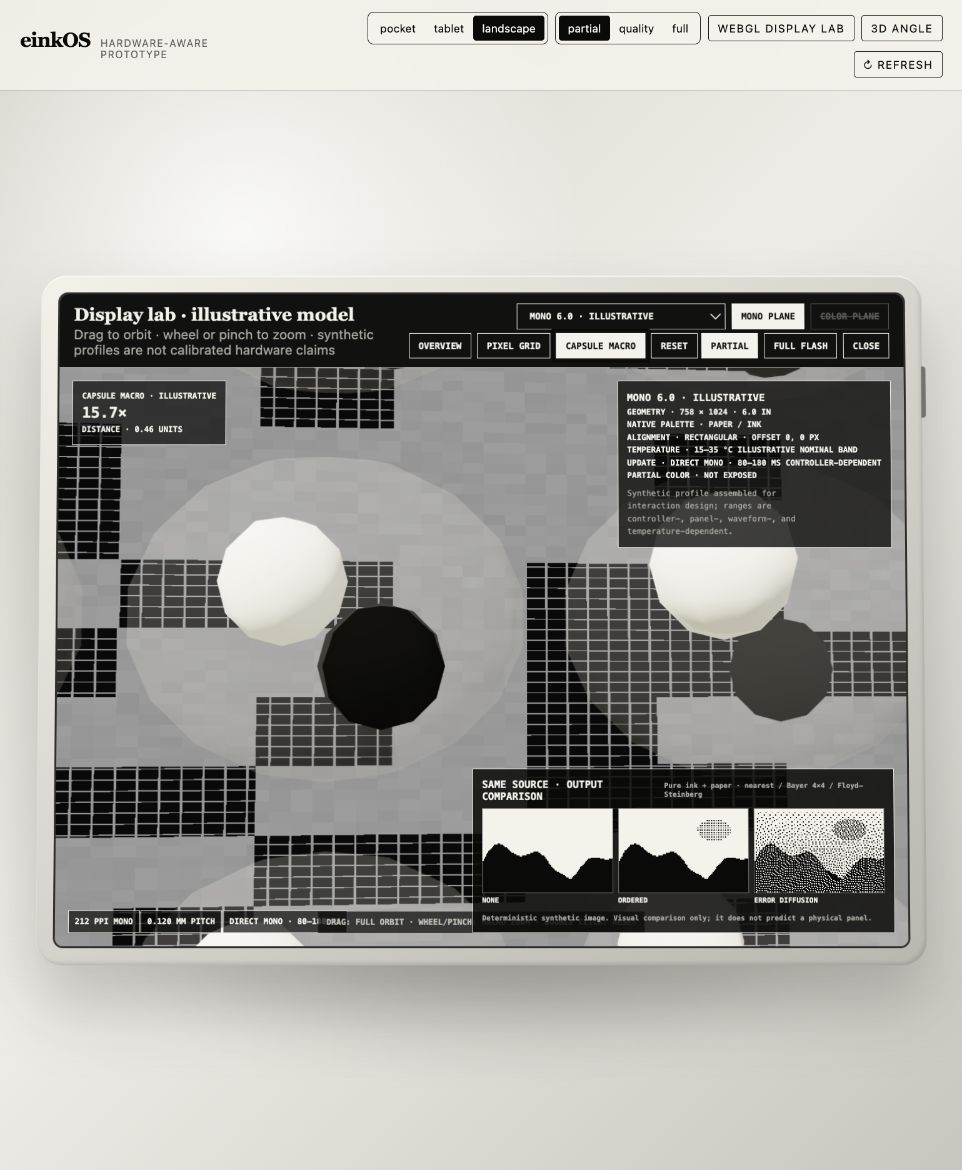
Hypothesis
If the emulator can move continuously from a full reflective device to page texture, pixel geometry, and a capsule-scale construction, we can discuss display quality without relying on vague “looks like e-ink” impressions.
What changed
- Unrestricted yaw and pitch orbit.
- Wheel and two-pointer pinch zoom.
- Overview, Pixel Grid, and Capsule Macro presets.
- Live zoom and camera-distance readouts.
- Translucent capsule shells with separate black and white pigment particles.
- Event-driven rendering that stops after interaction settles.
What the red team rejected
- A permanent animation loop on a battery-first product.
- Calling approximate timing or geometry exact.
- A 122 PPI label that contradicted the named 6-inch 758 × 1024 geometry.
- A macro aesthetic presented without a provenance warning.
The lab is now inspectable, not calibrated.
The selected sample geometry is approximately 212 PPI and 0.120 mm pitch. That calculation is defensible. The capsule distribution, optical scattering, reflectance, ghosting, and temporal response are still conceptual until matched against a named film/controller/waveform/temperature capture set.
Next decision
Add data-driven mono and color profiles, then feed the same stable image through no-dither, ordered, and error-diffusion paths. The comparison must expose native palette, region constraints, timing range, temperature band, and provenance instead of adding a cosmetic “color” switch.