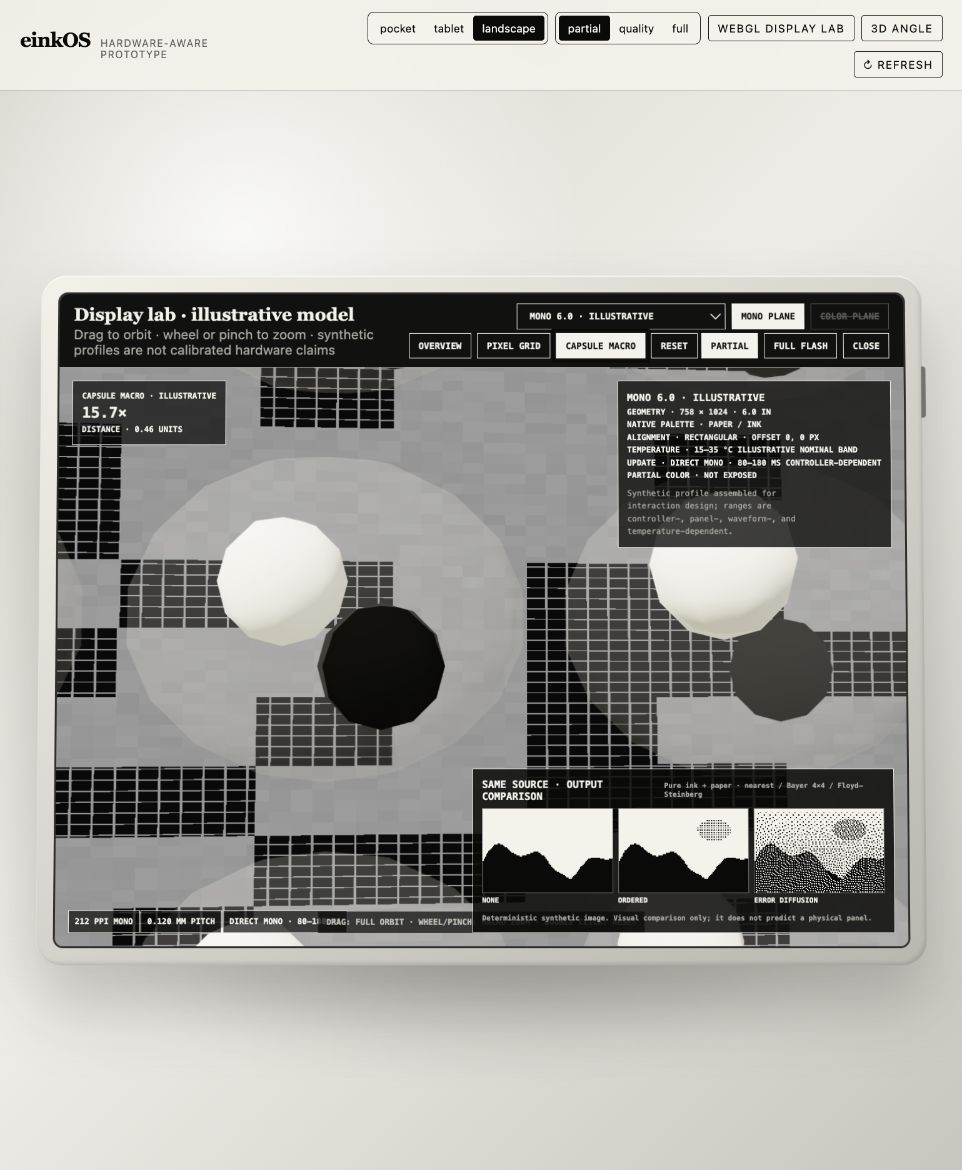
From the whole page to a single capsule
The inspection lab now moves from device-scale orbit to pixel-grid and conceptual pigment-capsule views. Wheel, pinch, and full rotation make the panel inspectable instead of decorative.
We are prototyping an operating system that treats every refresh, radio wake, and CPU slice as a deliberate expense.
Pure black and white until information earns another level.
No work, network, or wake-up without a declared budget.
Capabilities come from the panel and controller, not wishful APIs.
Claims graduate only with captures, traces, or measurements.
The inspection lab now moves from device-scale orbit to pixel-grid and conceptual pigment-capsule views. Wheel, pinch, and full rotation make the panel inspectable instead of decorative.

The first interactive shell is taking shape across pocket, reader, and desk-panel sizes. Every control is being judged by one question: does this deserve a display update?
A normal UI assumes it can redraw constantly. E-ink OS starts with regions, urgency, waveform intent, and a ghosting budget. The compositor may merge, delay, downgrade, or reject work before a driver sees it.
Direct monochrome updates, grayscale clears, pen modes, color pigment transitions, temperature bands, and controller-local features all make different bargains. The hardware profile must expose capability—not pretend every panel behaves alike.
E-ink OS is an open experiment in building an operating system around bistable displays from the first instruction: black and white first, sleep by default, bounded work, and no hidden 60 fps assumptions.
Follow the architecture decisions, failed experiments, panel research, emulator captures, and red-team corrections as they happen.